[ad_1] In December, we kicked off the agentic era by releasing an experimental version of Gemini 2.0 Flash — our highly efficient workhorse model for developers with low latency and enhanced performance. Earlier this year, we updated 2.0 Flash Thinking Experimental in Google AI Studio, which improved its performance by combining Flash’s speed with the ability to reason through more complex problems.And last week, we made an updated 2.0 Flash
[ad_1] Our next iteration of the FSF sets out stronger security protocols on the path to AGIAI is a powerful tool that is helping to unlock new breakthroughs and make significant progress on some of the biggest challenges of our time, from climate change to drug discovery. But as its development progresses, advanced capabilities may present new risks.That’s why we introduced the first iteration of our Frontier Safety Framework last
[ad_1] Responsibility & Safety Published 17 December 2024 Authors FACTS team Our comprehensive benchmark and online leaderboard offer a much-needed measure of how accurately LLMs ground their responses in provided source material and avoid hallucinationsLarge language models (LLMs) are transforming how we access information, yet their grip on factual accuracy remains imperfect. They can “hallucinate” false information, particularly when given complex inputs. In turn, this can erode trust in LLMs
[ad_1] While video models often “hallucinate” unwanted details — extra fingers or unexpected objects, for example — Veo 2 produces these less frequently, making outputs more realistic.Our commitment to safety and responsible development has guided Veo 2. We have been intentionally measured in growing Veo’s availability, so we can help identify, understand and improve the model’s quality and safety while slowly rolling it out via VideoFX, YouTube and Vertex AI.Just
[ad_1] A note from Google and Alphabet CEO Sundar Pichai:Information is at the core of human progress. It’s why we’ve focused for more than 26 years on our mission to organize the world’s information and make it accessible and useful. And it’s why we continue to push the frontiers of AI to organize that information across every input and make it accessible via any output, so that it can be
[ad_1] Research Published 5 December 2024 Advancing adaptive AI agents, empowering 3D scene creation, and innovating LLM training for a smarter, safer futureNext week, AI researchers worldwide will gather for the 38th Annual Conference on Neural Information Processing Systems (NeurIPS), taking place December 10-15 in Vancouver,Two papers led by Google DeepMind researchers will be recognized with Test of Time awards for their “undeniable influence” on the field. Ilya Sutskever will
[ad_1] Technologies Published 4 December 2024 Authors Ilan Price and Matthew Willson New AI model advances the prediction of weather uncertainties and risks, delivering faster, more accurate forecasts up to 15 days aheadWeather impacts all of us — shaping our decisions, our safety, and our way of life. As climate change drives more extreme weather events, accurate and trustworthy forecasts are more essential than ever. Yet, weather cannot be predicted
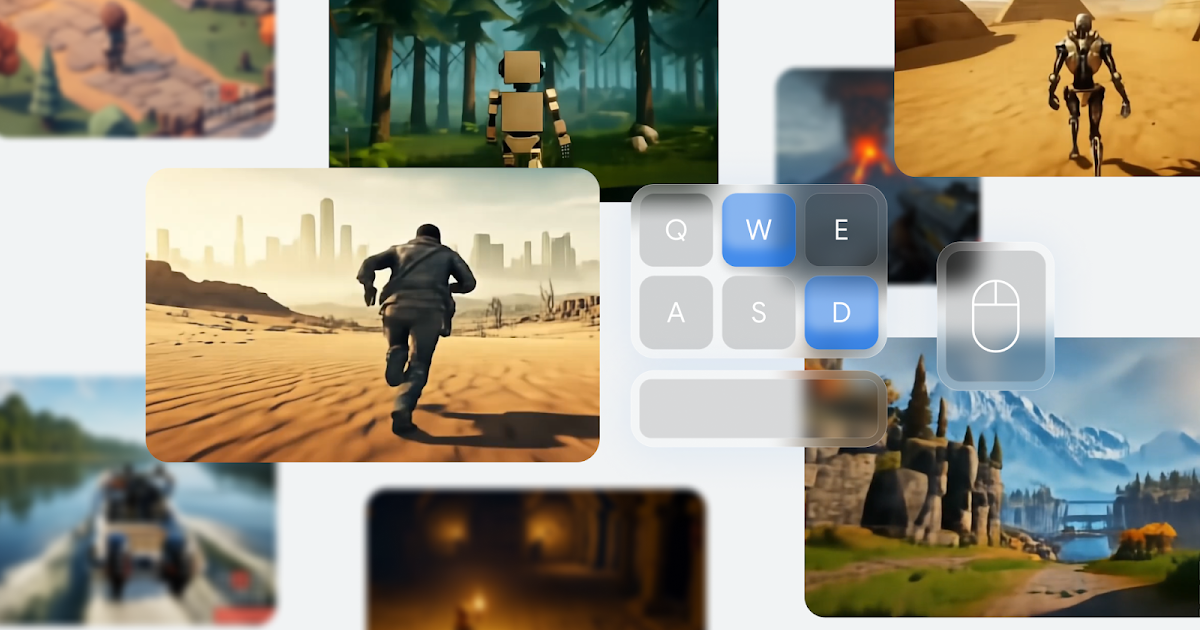
[ad_1] AcknowledgementsGenie 2 was led by Jack Parker-Holder with technical leadership by Stephen Spencer, with key contributions from Philip Ball, Jake Bruce, Vibhavari Dasagi, Kristian Holsheimer, Christos Kaplanis, Alexandre Moufarek, Guy Scully, Jeremy Shar, Jimmy Shi and Jessica Yung, and contributions from Michael Dennis, Sultan Kenjeyev and Shangbang Long. Yusuf Aytar, Jeff Clune, Sander Dieleman, Doug Eck, Shlomi Fruchter, Raia Hadsell, Demis Hassabis, Georg Ostrovski, Pieter-Jan Kindermans, Nicolas Heess, Charles
[ad_1] Quantum computers have the potential to revolutionize drug discovery, material design and fundamental physics — that is, if we can get them to work reliably.Certain problems, which would take a conventional computer billions of years to solve, would take a quantum computer just hours. However, these new processors are more prone to noise than conventional ones. If we want to make quantum computers more reliable, especially at scale, we
[ad_1] AI is revolutionizing the landscape of scientific research, enabling advancements at a pace that was once unimaginable — from accelerating drug discovery to designing new materials for clean energy technologies. The AI for Science Forum — co-hosted by Google DeepMind and the Royal Society — brought together the scientific community, policymakers, and industry leaders to explore the transformative potential of AI to drive scientific breakthroughs, address the world's most